
The Empty Booth Problem: If You Can’t See It Work, It’s Not Equipment


I just got back from Atlanta, and I have a bit of a Modex hangover. If you weren’t there, imagine a million square feet of the most expensive, shiny, and complex technology on the planet. We’re talking booths the size of city blocks, neon lights everywhere, and enough LED screens to power a small country.
But I noticed something weird.
Walking through the show floor, I saw dozens of massive booths: the kind that cost millions just to set up: that didn't have a single piece of equipment actually moving. Instead, they had VR goggles. They had polished 3D animations on 80-inch TVs. They had "concept models" sitting still under spotlights.
And a lot of those empty booths belonged to the big integrators.
That matters. These are the companies that are supposed to be the best at tying big systems together and making complex hardware run in the real world. So when the biggest names in integration can’t put live hardware on the floor, I see that as a bellwether. It tells you something is changing.
It signals a shift in what’s actually practical for the mid-market.
If the biggest integration firms are leaning on renderings, videos, and controlled demos instead of live, working equipment, that’s a clue. The industry is moving away from giant custom systems as the default answer. People want automation that can show up, plug in, and do the job without a six-month engineering event.
It got me thinking: If you can’t make the equipment work in a controlled trade show booth with a 20-person support crew and six days of setup time, how on earth is it going to work in your facility on a Tuesday at 2:00 AM when things are actually busy?
At Approach Automation, we call this the "Empty Booth Problem." And it’s the biggest red flag in the industry.
The "Death Star" Distraction
Look, I’m not here to bash big tech. Some companies: the global giants moving millions of units an hour: actually need what I call "Death Star" systems. These are massive, multi-year construction projects. They involve bolting things to the floor, custom-coding for six months, and hiring a specialized engineering team just to keep the lights on.
If you are Amazon, you might need a Death Star. But for the rest of us? For the mid-market warehouses, the hospitals, the schools, and the regional manufacturing plants? A Death Star is just a really expensive way to go bankrupt.
The problem is that these massive systems have become the "standard" for what automation is supposed to look like. We’ve been told that if it’s not a $10 million "science project," it’s not real automation.
That is a lie.

Automation as Equipment, Not Projects
The biggest shift we need to make in our heads is moving away from "projects" and moving toward "equipment."
Think about a forklift. When you need to move a pallet, you don’t start a three-year digital transformation project. You don’t hire a consultant to spend six months mapping your "material flow journey." You buy a piece of equipment. It shows up on a truck. You show the operator how to use it. It starts moving stuff that afternoon.
That is how automation should work.
If a robot needs a week of construction and a team of software engineers just to show up at a trade show, it’s a "project." If it’s something you can wheel in, show it the floor, and let it start working, it’s "equipment."
At Approach Automation, we focus on the stuff that works like equipment. We aren't interested in the "science project" vibe. We want things that solve problems today, not in 2028. We talked about this a bit in our Modex Day 3 recap, but the message bears repeating: don't let the shiny lights distract you from real, boring ROI.
The "Boring" Math: The 40-Move Guideline
Let’s talk about the math, because this is where people get stuck. They think they need to automate their entire facility to see a return. They think they need a massive fleet of a hundred robots.
They’re wrong.
Here is the "Simple Win" guideline: if you have a person moving around 40 loads a day: whether that’s trash, pallets, or parts: that is usually a strong signal that the workflow is worth a closer look.
It is not a magic cutoff. It is a guideline.
The point is simple: even small opportunities can be great places to start, as long as the movement is clearly defined and the benefit is real. You need to know what is moving, how often, how far, what labor it ties up, and what problem you are actually solving.
Forty moves can be enough. Sometimes fewer can still make sense. Sometimes more still does not. The number is just an indicator that there may be a practical, boring win sitting right in front of you.
Most people in a warehouse are walking miles every day just to move one thing from Point A to Point B. They aren’t adding value while they’re walking; they’re just being a very expensive human conveyor belt. When you treat automation like equipment, you stop trying to fix the whole world and you just fix that one walk.
You can read more about why the best automation is actually boring. Boring is predictable. Boring is profitable. Boring means you get to go home on time.

The Four Pillars of Keeping it Simple
We don't use fancy jargon at Approach Automation. We don't talk about "synergistic logistics optimization." We have four pillars. This is what we do:
1. We Clean Stuff
Cleaning is one of the easiest labor leaks to miss. It always has to get done, so people stop questioning it. But if you have someone pushing a broom, riding a scrubber, or dragging bins to the dumpster for four hours a day, that is four hours of labor disappearing into work that does not directly ship, build, or receive anything.
That is why cleaning is such a good "Simple Win." Autonomous scrubbers are the ultimate equipment-first play. You do not need to rebuild the building. You do not need a giant software project. You just let the robot clean the floor.
There is another reason this matters: clean floors help everything else work better. Dust, stretch wrap, cardboard scraps, and random debris are bad for safety and bad for robot navigation. If you want mobile automation to run reliably, the floor has to be predictable. Clean floors are not just a housekeeping issue. They are part of the operating system.
And cleaning is not only about scrubbers. Autonomous trash hauling is another boring win. If someone is spending part of every shift moving bins to the compactor, that is exactly the kind of repeatable task that should be handed to equipment. Between floor cleaning and trash runs, it is not hard to give back four hours of labor a day without touching your core process.

2. We Move Stuff
The walk is killing your margins.
Most facilities do not have a "robot problem." They have a walking problem. A lot of workers spend huge chunks of the day just moving things from Point A to Point B. In many operations, people burn 60% of a shift walking. That is not value-added work.
That is an expensive human conveyor belt.
This is where the "40-move" guideline becomes useful. Whether it is pallets, parts, carts, linen, trays, or trash, moving stuff shouldn't require a human to walk five miles a day. If you can redirect even a few hours of walking per shift into actual production, shipping, or customer-facing work, the math gets real fast. Across a year, that can easily turn into more than $100,000 in labor value.
The goal is not to automate everything. The goal is to automate the dumb walk. Fix one route. Fix one handoff. Fix one repeatable loop and let your team spend more time doing work that actually matters.
This is also where the AGV versus AMR conversation matters. AGVs are great when you have fixed paths, repeatable routes, or tugger-train style moves. AMRs are better when the environment changes and the robot needs to navigate dynamically around people, forklifts, and daily chaos. Different tools for different workflows. The point is not the acronym. The point is stopping all that wasted walking.
3. We Store Stuff
You don't need a 40-foot tall automated storage and retrieval system (ASRS) to get better at storage. Sometimes, you just need better tracking and a smarter way to slot your inventory. We focus on scalable storage solutions that don't require you to rebuild your warehouse.
I had a recent conversation with an ASRS builder that stuck with me. They said they are seeing great ROI at both ends of the spectrum: very small, high-throughput systems and large, slow-moving systems. That is a useful reminder that there is no one perfect automation profile.
The key is matching the system to the specific problem. A compact high-throughput ASRS can make sense when speed and density matter in a small footprint. A larger slow-moving system can make sense when the pain is storage, labor, or space utilization over time. The right answer depends on the workflow, not the trend line.
That is the whole point. Not every problem needs the same machine. Not every facility needs the biggest thing on the market. If all you have is a hammer, everything looks like a nail. We try hard not to think that way.
4. We Track Stuff
A lot of operations do not have a storage problem first. They have a hide-and-seek problem.
If you spend half your day looking for a pallet, a cart, a tote, or a bin, that is not just annoying. That is a data problem. You do not need more automation layered on top of confusion. You need to know where things are, in real time, without sending three people on a scavenger hunt.
That is why tracking stuff is the foundation of everything else. If you do not know where it is, you cannot move it automatically. You cannot store it intelligently. You cannot replenish it on time. You cannot trust your own operation.
Good tracking is boring in the best way. It gives you real-time visibility so you stop over-ordering parts you already have and stop running into stockouts because something was sitting in the wrong place. It cuts down on searching, second-guessing, and all the little delays that stack up all day long.
This is not flashy stuff. That is exactly why it matters. When tracking gets better, everything downstream gets easier.
The Right Level of Automation
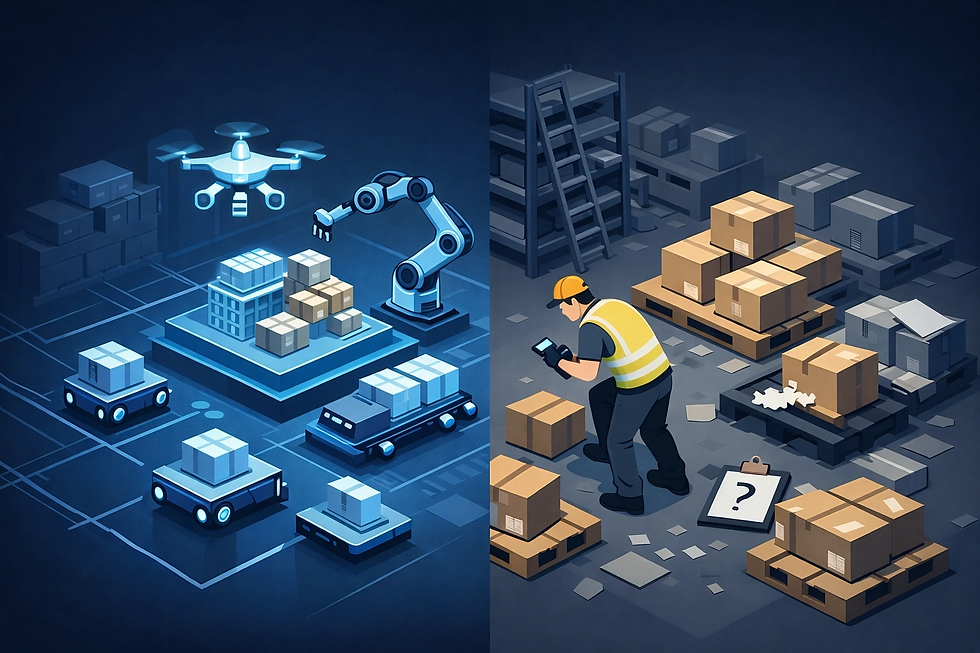
The biggest lesson from the show floor is that just because something is possible doesn't mean it’s practical.
There is a "Goldilocks zone" for automation.
Too Little: You’re stuck in the forever manual trap, struggling to find labor and falling behind the competition.
Too Much: You’ve built a Death Star that requires a team of engineers to maintain and takes three years to pay for itself.
Just Right: You’ve deployed "automation as equipment." It’s flexible, it’s iterative, and it solves a specific problem right now.
If you’re a mid-sized business, you should be aiming for "Just Right." You want the level of automation that lets you compete with the big guys without having to bet the entire company on a single project. We’ve put together a framework for finding that fit because we see so many companies get it wrong.
Where Approach Automation Fits
This is also where Approach Automation is different.
An OEM usually has one or two products to sell. A large integrator usually wants to build a massive system. That does not make them bad actors. It just means they tend to see the world through the lens of what they already offer.
We come at it differently.
Our job is to help you find the right fit for the actual problem. Sometimes that is a scrubber. Sometimes it is an AMR. Sometimes it is an ASRS. Sometimes it is better tracking. Sometimes it is a small deployment that solves one ugly workflow and pays back fast.
We are not trying to force a giant project into a building that does not need one. We are trying to find the smallest practical win that makes your operation better now and can scale later if you want it to.
Don't Buy the Hype, Buy the Equipment
Next time you see a flashy video of a robot doing a backflip or a trade show booth with more TVs than hardware, ask yourself: How long does it take to set that up?
If the answer involves months of integration and a "digital twin" that costs more than the robot itself, walk away.
Automation doesn't have to be a disaster. It doesn't have to be a three-year project. It can be as simple as a tool that helps your team do more with less.
At Approach Automation, we’re here to help you get unstuck. We want to help you find those "Simple Wins" that drive real ROI in weeks, not years. Whether you're in a warehouse, a hospital, or a school, the goal is the same: Clean, Move, Store, Track.
Let's stop building science projects and start getting to work.
If you're ready to stop looking at empty booths and start seeing real results, let’s talk. We’ll help you find the right place to start.


Comments