
The Manufacturing of Surprise: Why Your Automation Fails and Your Team Gets Blamed

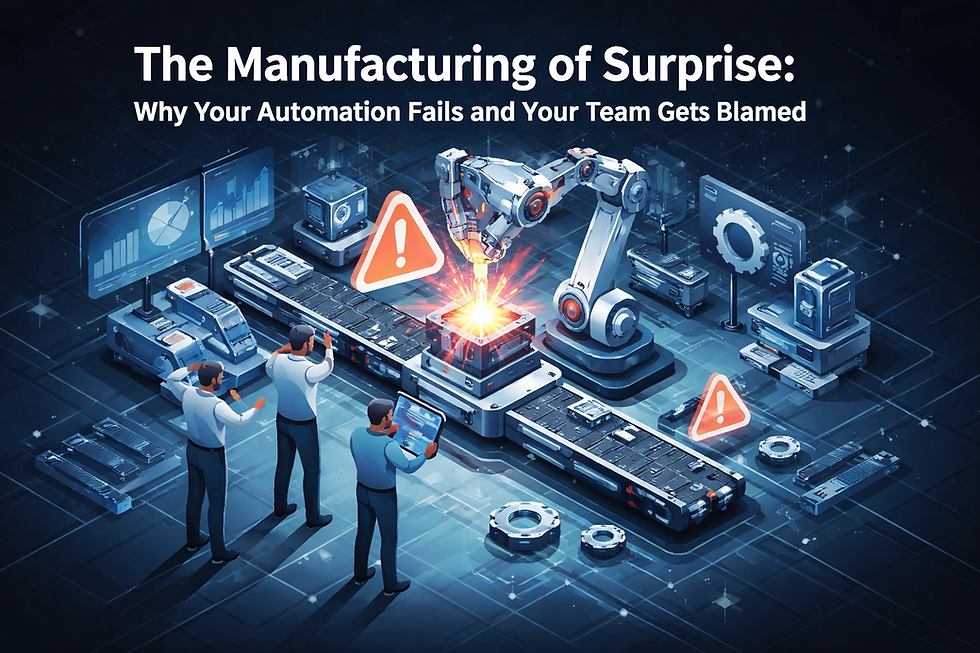
I didn't spend years building the perfect system; I spent years in operations dealing with the aftermath of a perfectly built system that was fragile and couldn't work if we just followed the SOPs.
Something would break, a deadline would slip, and the same frustrated questions would show up: Why didn’t the team follow the SOP? Why wasn’t this caught sooner?
It took a few hard lessons to see the real problem. The “surprises” that kept blowing up the work weren’t random bad luck. They were built in from the start. These systems failed because they were built on unexamined assumptions, not operational reality.
Here’s what I learned about why our systems fail—and why it’s almost never the team’s fault.
Surprise Doesn't Come From Unexpected Events
Let's get one thing straight. Surprise in automation is rarely caused by unexpected events.
It's caused by unexamined assumptions.
Assumptions about stability. You assumed demand would stay predictable. It didn't.
Assumptions about labor. You assumed your team would always be fully staffed. They weren't.
Assumptions about recovery. You assumed when something broke, you'd bounce back fast. You didn't.
These assumptions aren't reckless. They're inherited. They come from environments where variability is controlled instead of absorbed. They come from sales presentations and ROI projections that looked great on paper.
When those assumptions meet reality: the messy, unpredictable reality of a Georgia distribution center or an Atlanta-area warehouse: the system behaves exactly as designed.
The surprise belongs to the people who expected something else.
You Designed the Surprise
Here's what most leaders miss.
Surprise is manufactured during design, not during failure.

When you spec out a rigid material flow automation system that assumes consistent throughput, you're building in future surprise. When you install an automated storage and retrieval system without thinking about what happens when SKU counts triple, you're setting yourself up.
Most systems also get designed off historical data and a guess about future volume. That sounds reasonable. It usually isn't. It's error causing error: using static past information to build a rigid solution for a future that is guaranteed to be different. That's not just a guess. It's a compounding mistake that leads directly to operational surprise.
The failure isn't a bug. It's a feature of the original design.
Research backs this up. Automation projects often fail not because teams are incompetent, but because they're planned in management silos without input from the people who actually work with the processes daily.
Your floor team sees the strain. They see where the bottlenecks form. They know which assumptions don't hold up.
But nobody asked them.
Why Blame Shows Up Later
When systems finally struggle visibly, the response is predictable.
Blame.
Why didn't people follow the process?
Why wasn't this escalated sooner?
Why didn't the system handle this?
These questions focus downward. They miss the real issue entirely.
Your people were doing exactly what the system required to function. They were compensating for design choices that didn't reflect reality. They were holding things together with duct tape and overtime.
Blame is what shows up when ownership was absent earlier.

Think about it. When automation underperforms, root causes often remain unclear because there's no visibility into why systems fail. It's easier to point fingers at human error than admit the design was flawed from the start.
Your team didn't fail you. The plan did.
The Shift: Visibility Over Performance
So what's the fix?
It starts with a subtle but powerful shift in thinking.
Instead of asking: How do we maximize performance?
Leaders must ask: How do we make strain visible?
Systems that hide strain encourage optimism. They look good on dashboards. They hit KPIs: until they don't.
Systems that surface strain encourage learning. They show you where effort accumulates. They give you a chance to decide whether that effort is acceptable or whether the design needs to change.
Visibility doesn't mean failure. It means honesty.
Flexible Warehouse Automation That Absorbs Reality
This is where flexible warehouse automation changes everything.
Rigid systems break under pressure. Flexible systems bend.
At Approach Automation, we help mid-market businesses put in systems that fit real life. Not perfect life. Real life. We work with manufacturers, distributors, warehouses, and other busy operations that need practical material flow automation without getting locked into something rigid.
Here's what that looks like in practice.
Automated mobile robots (AMRs) that reroute themselves. When a path is blocked or demand shifts, AMRs don't stall out. They find another way. That cuts down The Walk: all that useless travel time that eats hours every week.
Modular storage systems that grow with you. Our automated storage and retrieval systems aren't built for one frozen moment in time. As inventory changes, the system can change too.
Floor care automation that runs in the background. Our Clean Stuff systems handle repetitive cleaning so your team can stay on work that actually needs a person.
Forklift vision and pallet-level tracking that end the hide-and-seek game. This is the fourth pillar: Track Stuff. Forklift vision from Zimark and pallet level tracking software help you see where pallets really are, not where someone hopes they are. That is how you cut Ghost Inventory and stop wasting time hunting for missing product.

The goal isn't to eliminate humans. It's to stop asking humans to cover for bad design.
Simple Wins: Clean, Move, Store, Track
You don't need to automate everything at once. In fact, trying to do too much too fast is one of the biggest reasons automation stalls out.
Start with simple wins.
Clean Stuff. Autonomous floor sweepers keep your facility safe and presentable without pulling labor from higher-value tasks. It's not glamorous. It works.
Move Stuff. Material flow automation with AMRs helps cut the endless walking, forklift bottlenecks, and missed handoffs. Your stuff gets where it needs to go.
Store Stuff. Automated storage and retrieval systems that flex with your SKU count mean you're not boxed in by decisions made three years ago.
Track Stuff. Forklift vision and pallet level tracking software give you visibility at the pallet level, so your team is not stuck playing Hide-and-Seek with inventory.
This is the kind of boring ROI that matters. Less walking. Less searching. Fewer misses.
Fewer "we thought it was there" moments.
And this is where Labor Realism matters.
Human-in-the-Loop is not a failure. It is the strategy.
Let robots handle the boring 80%: the repeatable moves, the long travel, the routine cleaning, the constant scanning. Let people handle the exceptions, the judgment calls, and the weird stuff that always shows up in real operations.
That mix works. Especially for mid-market businesses that need progress now, not a giant transformation plan later.
These aren't moonshots. They're practical wins that build trust fast.
Stop Inheriting Bad Assumptions
Here's the bottom line.
Most automation failures aren't caused by bad teams. They're caused by inherited assumptions that nobody questioned.
Assumptions get baked into system design. Design creates constraints. Constraints create strain. Strain gets hidden: until it can't be hidden anymore.
Then everyone acts surprised.
But you're not actually surprised. You're just seeing what was always there.
Design for What's Real
The companies that win at automation aren't the ones with the biggest budgets or the fanciest robots.
They're the ones that design for reality.
They involve their floor teams early. They build in visibility. They choose flexible warehouse automation that can adapt when: not if: conditions change.
They stop manufacturing surprise.

If you're running a warehouse or distribution center in Georgia and you're tired of systems that look good on paper but fall apart in practice, let's talk.
At Approach Automation, we help you build automation that works with your reality: not against it. No blame games. No hidden strain. Just simple systems to clean stuff, move stuff, store stuff, and track stuff.


Comments