
Stop Asking What's Next. Ask What's Now.

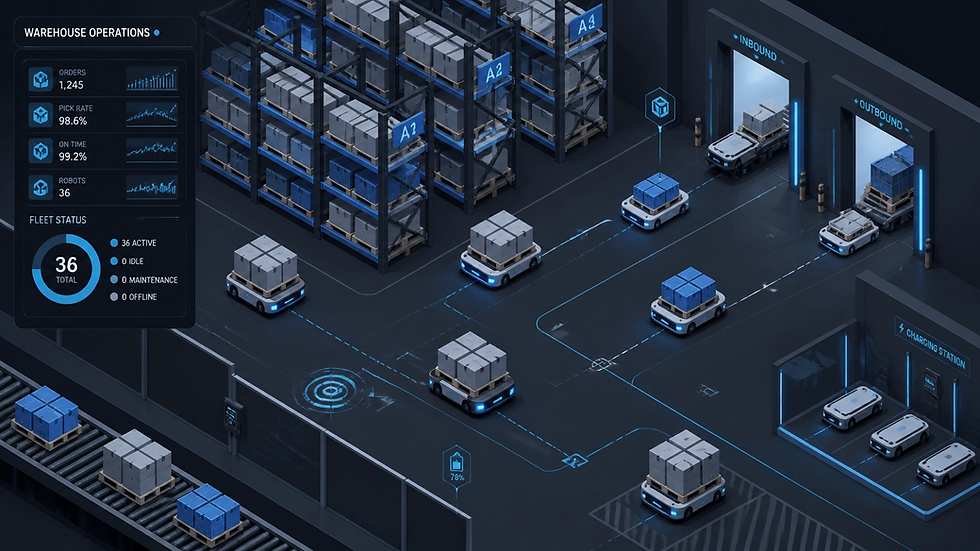
Walk into almost any industry conference or executive briefing today, and you will hear the exact same conversation. Everyone is breathless about what is coming next. People are talking about humanoids folding laundry, general artificial intelligence running logistics networks, and drones buzzing overhead in a completely lights-out facility.
It sounds incredible. It makes for great keynote slides and flashy headlines.
There is just one small problem. While everyone is staring at the horizon waiting for science fiction to arrive in a shipping container, the actual floor of the facility is messy. Pallets are stacking up in receiving. Floors need to be swept. Material needs to flow from point A to point B without someone pulling a manual hand truck across three hundred yards of concrete every ten minutes.
The most expensive thing in operations right now isn't labor. It isn't energy costs or supply chain volatility.
It is waiting.
The Paralysis of the Next Big Thing
Waiting for technology to mature is a silent killer of operational momentum.
Too many leaders fall into the trap of strategic paralysis. They look at emerging capabilities and think, "Well, humanoid robots are developing fast, so maybe we should hold off on any material handling upgrades for eighteen months until the second-generation units drop." Or they assume that because artificial intelligence is evolving every week, whatever they buy today will be obsolete by next quarter.
So they do nothing. They stick with manual processes, sticky notes, clipboards, and brute-force labor.
Meanwhile, time marches on. Every single week spent waiting for the perfect, ultimate, frictionless future state is a week of bleeding efficiency. The pallets still need to move today. The dust still accumulates on the warehouse floor tonight. The bottlenecks in material flow are costing real money right now, not in some hypothetical future scenario.
If you put off a practical deployment because you are waiting for a futuristic breakthrough, you are paying a heavy tax on inaction.

Automation Is Equipment, Not a Transformation Project
Part of the issue comes down to how people frame automation in their heads.
For decades, automation was treated as a massive capital expenditure project. It meant multi-million-dollar system integrators, plant-wide shutdowns, custom-engineered conveyors snaking through every corner of the building, and years of engineering studies. When projects are that painful, you have to wait for the absolute best technology before pulling the trigger, because ripping it out later is out of the question.
That mindset is completely outdated.
Modern automation should be viewed the same way you view a forklift, a pallet jack, or a desktop computer. It is equipment. You buy it, you plug it in, you train your team in an afternoon, and it starts working.
You don't wait for the ultimate smartphone before buying a phone to run your business. You buy what works today, knowing that technology always marches forward. Equipment can be deployed in weeks, not years. It solves a specific, localized headache without requiring a complete reinvention of the enterprise.
When you treat automation like deployable equipment rather than an existential corporate transformation, the fear of making the wrong choice evaporates. If a floor-sweeping robot or an autonomous mobile robot can clear your bottleneck this quarter, its ROI is paid long before the next generation of humanoid prototypes even makes it out of the research lab.

The Boring Truth About Real Efficiency
The media loves breakthroughs. Operators love boring, consistent execution.
If you look at where real operational gains happen day in and day out, they rarely come from revolutionary paradigm shifts. They come from eliminating friction in the most mundane, repetitive tasks imaginable.
Consider what actually drains energy in a facility:
Sweeping thousands of square feet of concrete floors by hand while dust builds up and impacts air quality.
Pushing heavy carts or driving manual forklifts across long, monotonous loops just to move inventory from production to staging.
Searching through dense racking for misplaced inventory because tracking systems rely on manual scanning and human memory.
These are not sexy problems. They do not require general artificial intelligence to solve. They require reliable, autonomous machinery that shows up, does the job without complaining, and frees up human workers to handle tasks that actually require human judgment and problem-solving.
An autonomous floor sweeper does not need to converse with you or climb stairs; it just needs to keep the floor clean 24/7. An autonomous mobile robot does not need a humanoid face; it just needs to transport a skid safely down an established aisle without running into a forklift.
When you strip away the hype, automation is remarkably simple. It cleans stuff. It moves stuff. It stores stuff. It tracks stuff.
Focusing on those four verbs changes everything.

Stop Planning for 2035
There is a distinct difference between having a long-term vision and using that vision as an excuse to procrastinate in the present.
Of course you should keep an eye on where robotics and logistics technology are heading. Keeping informed is part of running an operation. But letting tomorrow's possibilities paralyze today's progress is a recipe for falling behind competitors who are quietly deploying practical tools right now.
The companies that win aren't the ones waiting for the ultimate silver bullet. They are the ones solving immediate problems with immediate tools. They install the AMR today to handle point-to-point material transport. They bring in autonomous cleaning units this month to solve labor shortages in facility maintenance. They implement simple automated storage modules to reclaim floor space before the end of the fiscal year.
They make steady, practical, unglamorous progress.
So stop asking what is coming next. Stop holding your breath for the sci-fi revolution to knock on your loading dock.
Look at your floor right now. Look at where material flow is stalling. Look at where manual labor is being wasted on repetitive, mindless tasks.
Ask what is now. Deploy what works. And get to work.


Comments